
Angle Board: A Complete Guide to Uses, Benefits, and Applications
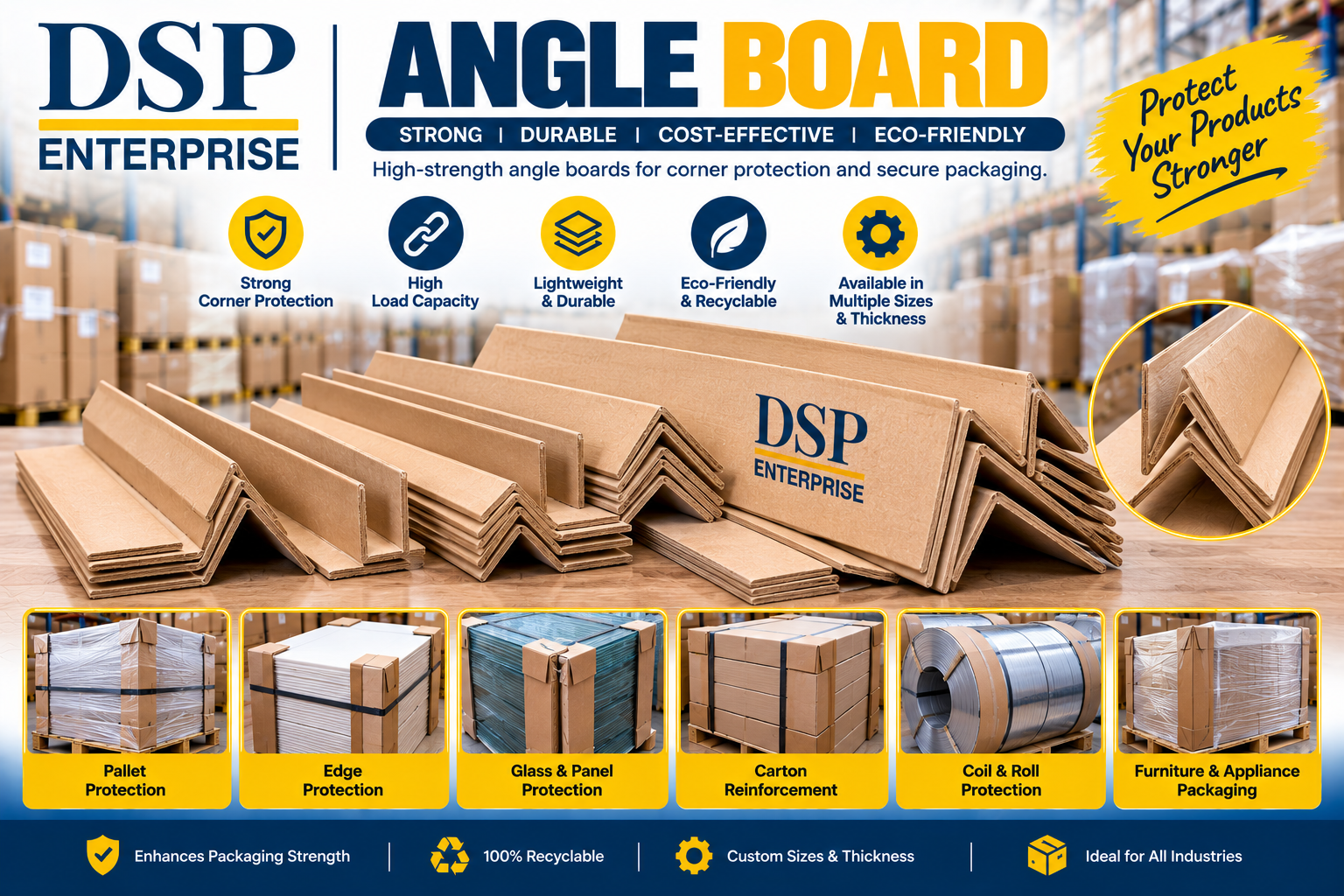
Angle board, also known as paper edge protector or corner board, is a protective packaging material designed to safeguard the edges and corners of products during storage, handling, and transportation. Made from layers of compressed paperboard, angle boards provide additional support to packaged goods and help prevent damage caused by impact, strapping, and stacking pressure.
They are widely used in industries such as logistics, manufacturing, furniture, textiles, appliances, and export packaging.
What Is an Angle Board?
An angle board is a rigid, L-shaped protective profile manufactured by bonding multiple layers of paperboard together. Its strong construction allows it to protect exposed product edges and corners.
Angle boards are available in different lengths, thicknesses, widths, and leg sizes, allowing businesses to select the appropriate specification for different packaging requirements.
Key Benefits of Angle Boards
- Protects corners and edges: Helps prevent dents, crushing, and impact damage.
- Improves load stability: Provides additional support to palletized goods.
- Distributes strapping pressure: Helps prevent straps from cutting into cartons or products.
- Enhances stacking strength: Supports the vertical edges of pallet loads.
- Lightweight: Easy to handle and apply.
- Customizable: Available in different sizes and thicknesses.
- Cost-effective: Provides valuable protection without significantly increasing package weight.
- Paper-based: Can generally be recycled through appropriate paper recycling systems.
Common Applications of Angle Boards
Angle boards are commonly used for protecting:
- Corrugated cartons
- Furniture
- Appliances
- Glass products
- Metal sheets and coils
- Textile rolls
- Doors and panels
- Ceramic products
- Palletized goods
- Industrial equipment
Angle Board for Pallet Packaging
Palletized products can experience pressure during transportation and stacking. Angle boards are placed along the vertical corners of the load before stretch wrapping or strapping.
They help reinforce the pallet and distribute external pressure across a larger area, reducing the possibility of crushed carton edges.
Angle Boards for Strapping Protection
Strapping can create concentrated pressure on the edges of cartons and pallet loads. Without adequate protection, straps may cut into the packaging.
An angle board placed underneath the strap helps distribute this pressure and protects the carton or product from deformation.
Angle Boards for Furniture Packaging
Furniture manufacturers and exporters use angle boards to protect sharp edges and corners during handling and transportation. They can be used along with corrugated sheets, stretch film, bubble wrap, or other protective packaging materials.
This combination can provide multiple layers of protection for finished furniture products.
Types of Angle Boards
- Standard Angle Board
Standard angle boards are suitable for general packaging and pallet protection applications.
- Heavy-Duty Angle Board
Heavy-duty versions are designed for applications involving heavier loads and greater stacking or strapping pressure.
- Customized Angle Board
Customized angle boards can be manufactured according to required dimensions, thickness, length, and application specifications.
How to Choose the Right Angle Board
When selecting an angle board, consider:
- Product weight
- Pallet dimensions
- Required board thickness
- Leg width
- Length of the protected edge
- Strapping requirements
- Stacking conditions
- Transportation distance and handling conditions
- Selecting the correct specification ensures that the angle board provides adequate support without unnecessary material usage.
Angle Board vs. Other Edge Protection Materials
Angle boards are particularly useful when both corner protection and load reinforcement are required. Compared with flexible packaging materials, their rigid structure provides additional support to palletized loads.
They can also be combined with stretch film, strapping, corrugated sheets, and other packaging products to create a complete protective packaging system.
Why Quality Matters
The performance of an angle board depends on factors such as paper quality, thickness, bonding strength, dimensions, and manufacturing consistency. A properly manufactured angle board should maintain its shape and provide reliable edge protection under the intended packaging conditions.
For high-volume industrial and export packaging, consistent-quality angle boards can help improve load stability and reduce packaging-related product damage.
Tips for Using Angle Boards
For effective protection:
- Position the boards vertically along exposed pallet corners.
- Ensure the board extends across the area requiring protection.
- Use suitable stretch film or strapping to hold the boards securely.
- Select stronger boards for heavy or high-stacked loads.
- Combine angle boards with other cushioning materials when products are particularly fragile.
- Store angle boards in a clean, dry environment.
Conclusion
Angle boards are an important component of modern protective packaging. They help protect product edges, reinforce pallet loads, distribute strapping pressure, and improve stacking stability during storage and transportation.
By selecting the appropriate angle board size, thickness, leg width, and strength, businesses can create safer and more efficient packaging solutions for everything from furniture and appliances to industrial and export shipments.
Find the right packaging for your business
Contact DSP Enterprise for product specifications and packaging solutions.
Request a Quote